
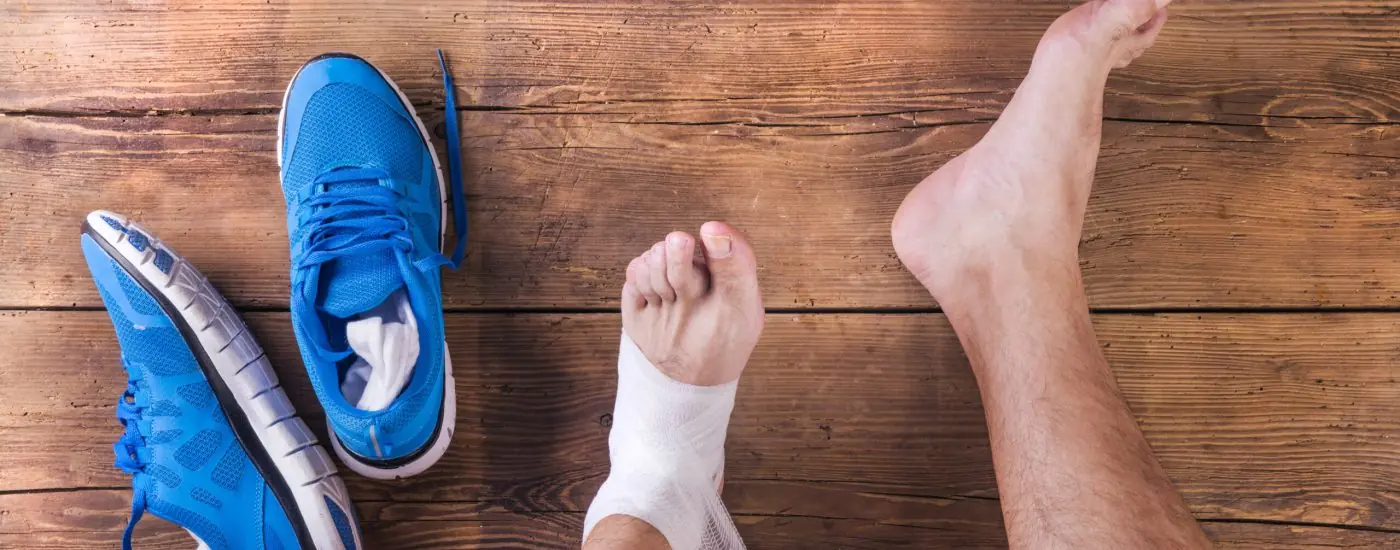
There is a pattern we see a lot in clinic. Someone trains, gets injured, rests, improves. They go back to training. And a few months later, the same problem comes back. Sometimes in the same leg, in exactly the same spot.
When this happens once, it looks like bad luck. When it happens two or three times, it is not.
What we usually find behind these relapses is not carelessness or bad luck. It is that the previous treatment resolved he symptom but never touched the cause.
And if the cause is still there, a gait pattern that always overloads the same area, footwear that does not properly support the sporting movement, the injury is simply waiting for the moment to return.
This is exactly what a well-directed podiatry consultation can change. It is not about treating today’s pain.
It is about understanding why your body keeps getting injured in that specific pattern, so next season does not repeat the same story.
The complaints that hide an underlying problem
Some sports injuries appear once, get treated, and never come back. But others tend to repeat themselves because their origin lies in something structural: how you walk or run, how your body distributes load, what footwear you use. These are the ones we see most often in active people.
Plantar fasciitis
This is one of the most common injuries among runners and people who train regularly. It feels like a stab of pain in the heel when taking the first steps in the morning, or when starting to walk again after sitting down.
The plantar fascia is the thick tissue running along the sole of the foot that cushions impact with every stride. When it is repeatedly overloaded: by increasing training volume too quickly, by a gait that does not distribute load well, or by worn-out footwear, that tissue becomes inflamed, and if the cause is not corrected, it tends to become chronic.
Shin splints
Also known as medial tibial stress syndrome, this is very common in runners and in anyone who plays sports involving jumps or changes of pace.
It shows up as pain along the inner side of the shin that worsens with running or jumping, eases with rest, and returns as soon as load is resumed.
It almost always involves a combination of factors: a sudden increase in training load, hard ground, running technique, and very often, gait alterations that nobody had checked before.
Overload and knee discomfort
Not all knee pain in athletes comes from the knee itself. A foot that rotates excessively inward or outward forces the knee to compensate for that rotation with every step.
Over time, that overload generates pain on the inner or outer side of the joint, particularly in amateur runners and footballers.
Treating only the knee in these cases usually brings temporary relief. The problem comes back if the gait that caused it remains unchanged.
Pain on weight-bearing after training
This is a sign many people normalise without giving it much thought. Noticing discomfort when putting weight on the foot, whether in the heel, the arch or the forefoot, right after training or the day after, usually indicates that some structure in the foot is bearing more load than it should.
It is not necessarily serious when it first appears. But it is exactly the kind of sign worth checking before it turns into an established injury.
Signs worth checking before things get worse
There are indicators that almost always precede these injuries, and that a podiatry consultation can assess before the problem worsens.
Uneven wear on footwear is one of the clearest. If the sole of your trainers wears down much more on one side than the other, or very noticeably at the heel or toe area, your gait is distributing load unevenly.
Pain that always appears at the same stage of training, at the start, after a certain distance, or the day after, is another sign worth noting. That repeated pattern usually points to a specific mechanical cause, not a one-off event.
Relapses after returning to training are perhaps the most important sign of all. If an injury improves with rest but reappears as soon as you resu me activity, it almost always means the symptom was treated without correcting what generated it.
Increasing training volume abruptly, more distance, more intensity, more frequency, without gradual progression, is one of the most common triggers of overload, especially when combined with a gait alteration that already existed without causing problems until then.
What is assessed in a podiatry consultation aimed at sport
When an active person comes to clinic with a recurring injury, we do not start by only looking at the area that hurts. We start by understanding the full context.
We ask which sport you do, how often, on what surface, since when the discomfort has been appearing, and whether it has happened before at some point. That information tells us a lot before we examine anything.
We then carry out a gait assessment, both static and dynamic. We look at how load is distributed across the foot while standing, and how that distribution changes when walking or running.
We look for asymmetries between one side and the other, excessive foot rotation, and areas that are clearly overloaded compared with the rest.
With that information, we identify whether the injury you have brought to clinic has a clear mechanical origin, and we design a plan that does not just treat the current symptom.
The goal of a properly conducted podiatry consultation is not only for the pain to stop now, but for you to understad what caused it, so the chances of it returning are reduced.
Footwear: the factor that almost always gets underestimated
There is a figure we repeat often in clinic because it surprises most patients: a large proportion of runners are estimated to have an inefficient gait without knowing it, and many continue using footwear that does not suit either their gait pattern or their sport.
Sports footwear is not just any accessory. In many cases, it acts as a corrective or compensating element for certain biomechanical alterations of the foot. Poorly chosen trainers can worsen a problematic gait; well-chosen ones can largely compensate for it.
Two things are worth checking regularly: that the footwear still retains its cushioning capacity: trainers lose these properties with use, well before it becomes visible to the naked eye, and that it genuinely suits your gait pattern and the sport you practise, not just whichever model happens to be trending that season.
Custom insoles, when indicated after a genuine biomechanical assessment, tend to be far more effective than generic insoles offered without prior evaluation. Not everyone needs them, but when they are needed, they make a noticeable difference in preventing relapses.
Why prevention works better when coordinated with physiotherapy
Podiatry can identify and correct the mechanical origin of many sports injuries. But an athlete’s body is not just the foot: it is muscle strength, joint mobility, running technique and the capacity to tolerate load.
That is why, when there is a recurring sports injury, we do not work on podiatry in isolation.
We combine it with physiotherapy to address what a gait assessment cannot resolve on its own: the strength of the muscles absorbing impact, ankle mobility, the technique of the sporting movement, and the appropriate load progression needed to return to training without risk.
A podiatry consultation that detects a gait alteration and corrects it with insoles or suitable footwear resolves one pat of the problem. Physiotherapy work, in parallel, strengthens what needs strengthening and helps the body tolerate training load better.
This combination is what genuinely reduces relapses. Not because one discipline is better than the other, but because each recurring sports injury usually has more than one cause, and addressing only one of them leaves the door open for the story to repeat itself.
Does a podiatry consultation make sense for your case?
If you train regularly and notice you always get injured in the same area, if your footwear wears down unevenly, or if a complaint improves with rest but returns as soon as you resume activity, there are good reasons to have it assessed.
At Fisio Physio Clinic Salinas we work on sport-focused podiatry in coordination with physiotherapy and other disciplines, because we know relapses almost never have a single cause.
We start by listening to your sporting history, we assess your gait under real conditions, and if we find something worth correcting, we design a plan that combines what your foot needs with what your body needs to get back to training with confidence.
We cannot promise you will never get injured again, that would not be honest, but we can help you understand what is generating that pattern of relapses, and work on it before next season starts exactly like the last one did.
If you want to know whether your case fits, a podiatry consultation is the best place to start.