
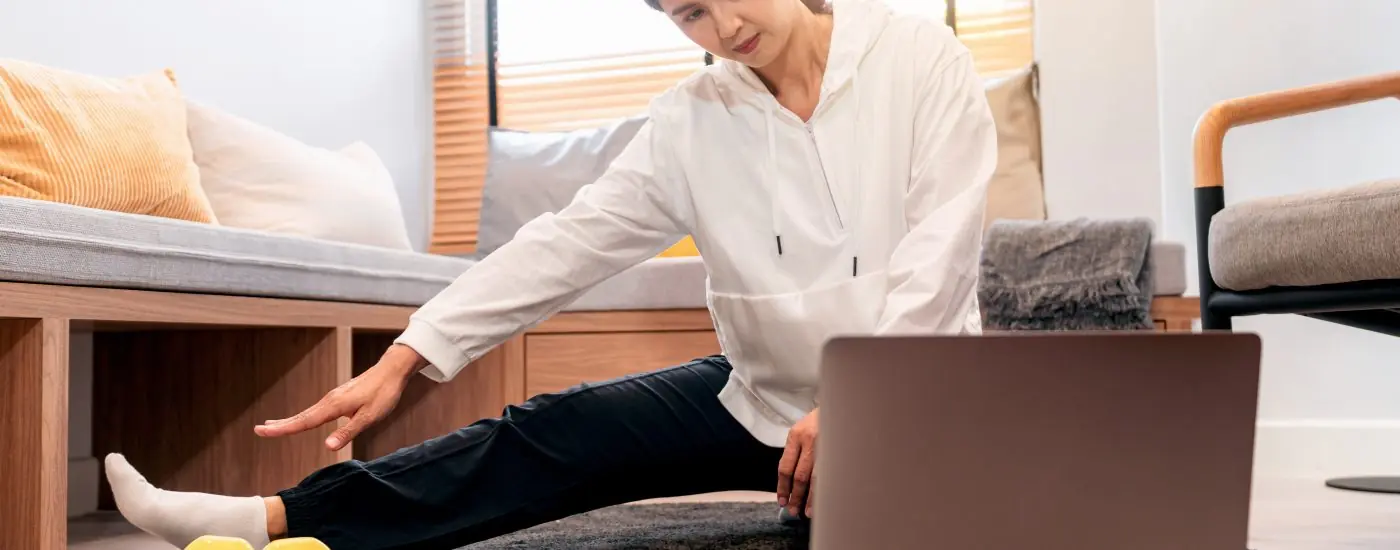
When you hear “telemedicine” or “online session”, maybe the first thing that comes to mind is something cold, impersonal, or just generic exercise videos.
But the reality is that a well-organised physiotherapy clinic can help you a lot from home too, especially if your problem is mechanical, you’ve had nagging pain for a while, and your biggest obstacles are time and travel.
If you’re reading this, chances are something like this is happening to you: you work long hours, spend the day between the computer, car, errands, family… and your back, neck, shoulder or knee has been complaining for months.
You’ve been to a clinic before, it helped, but now it’s hard to fit in face-to-face appointments and you feel like you keep ending up in the same place over and over again.
The idea of this article is to explain to you, without jargon, how telerehabilitation in physiotherapy works, in which cases it makes a lot of sense, in which it doesn’t, how to prepare a session from home and which mistakes are worth avoiding so it doesn’t become “just another attempt” that fizzles out halfway through.
What is telerehabilitation?
When we talk about telerehabilitation, we’re not referring to watching a YouTube video and copying the moves. We’re talking about real sessions with a physiotherapist, but using a screen as a bridge between your home and the physiotherapy clinic.
In an online session, we don’t “waste time” just filling minutes. You can do much more than it seems:
First, we talk: what hurts, since when, what things make it better or worse, what your day-today looks like, what you’ve tried before and what worries you. Just like we would do in the clinic.
Then, we assess your movement through the camera: how you bend, how you squat, how you lift your arm, how you walk around the room, how your neck behaves… That information helps us understand what type of pain we’re dealing with.
From there, we explain in simple words what might be going on in your case, what room for manoeuvre we have and what role exercise, movement and education will play in your recovery.
Finally, we guide you live through exercises, technical corrections, load adjustments and recommendations for your day-to-day life. And we make your “homework” between sessions very clear, so you don’t depend only on “what happens on screen”.
A generic exercise sheet is not the same as someone watching you, correcting how you squat, how you position your back or how you place your foot, and adapting the plan according to how you respond. That’s the difference between “online physiotherapy” and simply “looking up exercises on the internet”.
When does telemedicine in physiotherapy work especially well?
A good physiotherapy clinic won’t tell you that everything can be done online. That wouldn’t be very honest. But there are many cases where the remote format works really well, especially when the main focus is movement, strength and load management.
Mild to moderate mechanical pain
This includes many of the typical aches and pains:
- Back pain that changes depending on your posture.
- A neck that complains more at the end of the day in front of the computer.
- A shoulder that hurts when you lift your arm or lie on your side.
- A knee that shows up when you run or climb stairs.
These are pains that improve or worsen with movement and posture, where treatment is based on education, adjusting load, improving mobility and working on strength. All of that can be perfectly guided over video as long as you’re able to move a minimum.
Strength and maintenance programmes
Another common scenario: you’ve been assessed, you’ve had treatment, you’re better…and now it’s time to build strength, consolidate changes and prevent flare-ups. But it’s exactly at that stage when it’s hardest to stay consistent.
Here, telerehabilitation fits really well. You don’t need to go to the physiotherapy clinic every week so we can watch you do an exercise you could easily do at home: we review it online, correct your technique, increase or decrease the intensity, answer questions and adjust your programme so it makes sense with your real schedule.
Follow-up after discharge from in-person care
In many cases, a mixed model is ideal:
- An initial in-person phase, especially if there was intense pain or a clear need for manual therapy.
- A transition phase with some face-to-face sessions and some online.
- A mainly online maintenance phase, with periodic check-ins and exercise adjustments.
That way, you’re not “left on your own” once you walk out of the clinic: you have a professional on the other side of the screen following you up, correcting you and helping you make decisions when you notice your body starting to complain again.
When is it better to go in person to the physiotherapy clinic?
Just as important as knowing when telemedicine helps is being clear about when it isn’t enough. A serious physiotherapy clinic is not going to try to manage everything online.
Very intense pain or pain that “locks” you up
If you’re at a point where you can barely move, it’s hard even to get out of bed, or the pain shoots up with any tiny gesture, the screen falls short. In those situations, it often makes sense to:
- See how you react to direct touch.
- Assess muscles, joints and skin in more detail.
- Fine-tune the starting point for exercise and load in person.
From there, combining with online sessions can make sense. But the beginning is usually better done face to face.
Neurological signs or “red flags”
If, on top of pain, you notice:
- Continuous or very marked tingling in arms or legs.
- Clear loss of strength (you drop things, lose control).
- Changes in sensation (areas that go numb or feel “strange”).
- Problems controlling bladder or bowel, fever, unexplained weight loss…
In these cases, the first step is not to book a video call, but to rule out anything serious. The priority is a face-to-face assessment at the physiotherapy clinic and very often a medical review and further tests.
Need for very specific manual therapy
There are situations where tissue behaves in a way that’s worth exploring with hands-on assessment: joint blocks, certain scars, very localised pain points… Manual therapy is not the physiotherapist’s only tool, but sometimes it’s key.
In those cases, you might:
- Start with a few in-person sessions to calm down the most acute part.
- And then continue rehab and strength work online.
How to prepare a telerehabilitation session from home
You don’t need a full gym in your living room for a session to work. But it does help a lot to prepare the basics so the time you spend connected really pays off.
Space and camera
Ideally, you should be in a room where:
- You can take a few steps forwards and backwards.
- You can move your phone, tablet or laptop far enough away for us to see your whole body when needed.
- There isn’t a strong backlight behind you that turns you into a silhouette.
It doesn’t have to be perfect. But if your physio can see you clearly when you bend, raise your arms or walk, they’ll be able to correct and adjust things much better.
Comfortable clothing and simple equipment
Think about how you’d dress to go to the physiotherapy clinic: comfortable clothing that lets us see the area we’re working on if needed (knees, shoulders, back…). It’s not the best moment for stiff trousers or very tight shirts.
As for equipment, a little goes a long way:
- A stable chair.
- A towel or mat if we’re going to work on the floor.
- A resistance band if you have one, or a water bottle / backpack as a weight.
If you don’t have anything, we’ll start anyway: we can adapt and add bits over time if it makes sense.
Arriving “mentally” to the session
Even though you’re at home, try to treat that hour as if you were going out to the physiotherapy clinic. It helps a lot to:
- Let people at home know you need a bit of quiet time, as far as possible.
- Have a few notes on how your week has gone: which exercises were harder, when the pain showed up, what scared you.
- Come with one or two clear questions: that makes the session much more useful.
Common mistakes when doing rehab from home
Working from home has its advantages, but also some traps. There are mistakes we see again and again, both in people who train on their own and in those who start an online programme without proper support.
Doing too much on day one
It’s very human to think: “if they told me to do 10 reps, I’ll do 20 and progress faster”. The problem is that tissue (tendons, muscles, joints) needs time to adapt.
Suddenly loading a lot more often leads to:
- A jump in pain the next day.
- The feeling that “this isn’t for me”.
- Dropping the plan altogether.
With a physio on the other side, the idea is exactly the opposite: start with a dose your body can handle, see how it responds and then build from there. That’s the logic we follow both in telerehabilitation and in face-to-face work at the physiotherapy clinic.
Copying generic internet exercises
YouTube, Instagram, TikTok… are full of routines to “fix” your back, neck or knee in 5 minutes. The problem usually isn’t that the exercises themselves are bad, but that they’re not designed for your specific case.
Two people with low back pain might need almost opposite things: one to move more, the other to reduce load; one to work more into flexion, the other into extension; one to focus on strength, the other on mobility.
The role of the physiotherapy clinic, including online, is to help you choose which exercises make sense for you, in what order and with what progression. It’s not about doing “everything that’s supposedly good for the back”, but about what your back needs right now.
Never progressing
The opposite mistake is also very common: starting with an exercise sheet and repeating it exactly the same for months. Same reps, same weight, same intensity. That’s better than nothing, but it has a ceiling.
Your body adapts to what you ask it to do. If you never raise the challenge, there comes a point where it stops changing. That’s why, in both in-person and online sessions, we review:
- When it’s a good time to add more load.
- When to introduce more demanding variations.
- When it makes sense to stay at the same level a bit longer because your body still needs it.
Planned progression is one of the things that most clearly separates “doing exercises” from doing guided rehabilitation.
Face-to-face, online or mixed: how to decide what suits you?
There isn’t a single right answer. A good physiotherapy clinic doesn’t marry one format, but rather whatever helps you most.
In general:
- Some cases are better started in person: intense pain, clear need for manual therapy, diagnostic doubts, neurological signs. Once things are on track, it often makes sense to move to a mixed format.
- Some situations can be kept almost entirely online: strength programmes, maintenance, follow-up of mechanical pains that are already well understood.
- And for some people, the ideal is to combine: an occasional in-depth check-up at Fisio Physio Clinic Salinas, plus one or two online sessions a month to keep moving forward.
The key is not to see telemedicine as an “all or nothing”, but as one more tool we can use in your favour if it fits your case and your logistics.
Does it make sense for us to assess your case at Fisio Physio Clinic Salinas?
If you’ve been looking for a solution that fits your lifestyle, if the idea of starting from scratch again puts you off, or if you’re worried about losing quality by doing things remotely, the most honest thing we can tell you is this: when used well, the screen can be a real ally – but first we need to see if it fits you.
At Fisio Physio Clinic Salinas we can do an initial assessment (in person or online) to:
- Understand what type of pain you have and what’s feeding it.
- See how you move, what limits you and what scares you.
- Look at your reality: schedule, family, work, energy.
And from there, decide together whether a face-to-face plan, a mixed plan or a mainly remote plan makes the most sense.
The idea is not for you to become a tech expert or turn your living room into a gym, but for you to have access to the help of a physiotherapy clinic from home as well, with a measurable, adapted and adjustable plan.
If you see yourself in these lines and feel it’s time to stop improvising, the simplest next step is to book that initial assessment.
From there, we can explain clearly what we can do for you from the clinic, from the screen, or by combining both so that your rehabilitation finally fits into your real life.